
NSE Indices on Wednesday changed the methodology for handling schemes of demerger involving index constituents. The index provider said a company undergoing demerger would now be retained in its indices. The move comes ahead of the proposed demerger of Reliance Industries' (RIL's) financial services arm. Under the rules prevailing thus far, RIL -- which has the highest weighting among the 50 Nifty components -- would have been required to be removed from the index, resulting in a churn by funds tracking the Nifty index.

About 5.3 million fewer investors were active in March than they were nine months ago as sustained volatility weighed on sentiment. The number of active clients on the NSE, the country's largest bourse, stood at 32.7 million, down 5.3 million. This was 14 per cent lower than 38 million in July 2022.

Two listed firms belonging to the Baba Kalyani Group (BNK Group) have contested their inclusion as parties in a suit pertaining to family dispute over ownership of chemical firm Hikal. The co-promoters of the company - Kalyani and Hiremath families - are mired in a legal dispute, with the latter seeking transfer of ownership of shares held by the BNK Group, citing nearly three-decade old family arrangement. An affidavit filed in reply to Hiremath's suit petition in the Bombay high court, BF Investment (BFIL) and Kalyani Investment Company (KICL) have stated that they are separate and distinct legal entities and were not even incorporated and party to the 'family arrangement'.
The country's largest bourse National Stock Exchange (NSE) has put the NSE Prime initiative in cold storage following lukewarm response from India Inc, said people aware of the development. Inspired by Brazil's Novo Mercado, NSE had announced a separate platform which any listed company could be part of by voluntarily adopting a stricter corporate governance code. Launched in December 2021, NSE Prime was to formally take off within a year after empanelling companies.

Half the stocks in the Nifty 100 index have seen a reduction in their target price by analysts this year due to fears of lacklustre earnings growth and uncertain economic environment. Adani Green Energy, FSN E-Commerce (Nykaa), Adani Ports & SEZ and Indus Towers are among the companies that have seen the maximum cut in TPs during the first three months of calendar 2023, shows Bloomberg data. On the other hand, Canara Bank, JSW Steel and Bank of Baroda have seen the highest increase in TPs.

The BSE Realty index-a gauge of real estate stocks-rose 4.2 per cent on Monday, extending its two-day advance to 7.8 per cent. The latest gains came on the back of robust sales posted by realty developers in the March quarter of financial year 2022-23 (Q4FY23). On Thursday, the rate-sensitive index had gained 2.9 per cent following the Reserve Bank of India's decision to pause interest rate hikes in its latest monetary policy review.
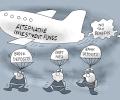
'Given that debt AIFs, by nature, target a higher portfolio return, it is likely to attract investors like HNIs, family offices, etc, looking for a higher yield debt product.'

Despite markets turning volatile, share sale activity at India Inc has surged to its highest level in five months. So far in March, promoters, strategic investors and other large shareholders have been able to offload shares worth more than Rs 33,000 crore-the most since November-defying uncertain market conditions. Both the Sensex and the Nifty are on course to post their fourth straight monthly loss amid headwinds, such as interest rate tightening by the US Federal Reserve and the global banking crisis.

Analysts say domestic banks' dependence on local depositors insulates them from the crisis.

UBS stepping in to save Credit Suisse with a $3.2-billion acquisition has provided the beleaguered Swiss bank's India employees a glimmer of hope. The surprise deal - engineered by the Swiss government - has triggered optimism of fewer job losses at Credit Suisse's India unit and better synergies at key verticals, such as wealth management and investment banking. "UBS is a much stronger hand. Coming within its fold will give Credit Suisse's wealth management and investment banking divisions a good home.

The filing of offer documents with the capital markets regulator - Securities and Exchange Board of India - has more than halved this financial year (2022-23, or FY23) as the outlook for new share sales has worsened, following correction in the secondary market. So far in FY23, 66 companies filed their draft red herring prospectus (DRHP), as opposed to 144 in the preceding financial year (2021-22, or FY22).

Heightened volatility and lacklustre returns continue to make a dent in retail participation in the equities cash market segment. The percentage of retail participation in the average daily turnover in the National Stock Exchange's (NSE's) cash segment has come down to 40.8 per cent in February 2023, from 52 per cent a year ago. At the peak, retail investors accounted for nearly two-thirds of cash market volumes in July 2020.

Financial services and consumer durable companies accounted for most of the selling by foreign portfolio investors (FPI) in the last fortnight of February. FPIs sold finance stocks worth Rs 2,263 crore and consumer durable stocks worth Rs 1,111 crore, according to data collated by Prime Infobase. Information technology (selling worth Rs 708 crore), metals and mining (Rs 694 crore), and power (Rs 497 crore) were the other sectors where overseas funds sold shares.

Equities are the go-to asset class as far as ultra-long-term returns are concerned. Over the past 123 years, global equities have provided an annualised real return of 5 per cent in US dollar terms, while bonds have delivered 1.7 per cent and short-term bills just 0.4 per cent, according to Credit Suisse's Global Investment Returns Yearbook 2023. In collaboration with the London Business School, Credit Suisse has analysed over 100 years of returns for key asset classes in 35 countries.
The Securities and Exchange Board of India's (Sebi's) proposal to re-introduce "hard underwriting" is seen as step to boost India's moribund initial public offering (IPO) markets. The regulator has proposed that in case an IPO fails to garner full subscription, the investment banker or a third-party can buy the unsubscribed shares. This practice was common during fixed-price issues prior to 1999. However, under the new book building regime, underwriting is allowed only to the extent of shortfall due to technical rejection of bids - this is referred to as "soft underwriting" and is rarely invoked.

Shares of Life Insurance Corporation (LIC) of India hit fresh record lows amid sustained decline in Adani Group stocks. Its stock finished at Rs 567.8, down 2.9 per cent over its previous close. The state-owned insurer's market value is now down Rs 2.4 trillion, or 40 per cent, compared to initial public offering levels.

There seems to be no respite for Adani Group companies from the market carnage. All 10 stocks belonging to the conglomerate came under a fresh bout of intense selling pressure on Wednesday as the group's debt levels and repayment capabilities continued to plague investors. Analysts said investors are also concerned about whether the group will be able to maintain its pace of growth, given the current turmoil that has wiped out over Rs 12 trillion in market capitalisation (m-cap) since the start of the year.

The Securities and Exchange Board of India (Sebi) has proposed to put a stop to the practice of certain directors occupying permanent board seats at listed companies. The regulator has suggested that the directorship of any individual serving on the board should be subject to periodic approval from shareholders, at least once in five years. In a discussion paper issued on Tuesday, Sebi said a few promoters enjoyed permanency on the board, giving them an undue advantage, prejudicial to the interests of public shareholders.

The rout in Adani Group stocks after US-based short seller Hindenburg Research released a report on January 24 has sparked a rebound in trading activity this month. The average daily trading volume (ADTV) for the cash segment (both NSE and BSE combined) so far in February stands at Rs 59,346 crore, and is around 15 per cent more than the previous month's tally of Rs 51,844 crore, which was the lowest in six months. The ADTV for the futures and options (F&O) segment rose to a record Rs 204 trillion (notional turnover) against Rs 202 trillion in January.

Friday will be a landmark day for domestic markets, with all the listed stocks entering the professed T+1 (trading plus one day) settlement cycle. About 200 stocks, which account for more than 80 per cent of India's market capitalisation, will be settled on a next-day basis, with effect from January 27. This will evidently complete the transition to the T+1 cycle that started in February 2022 with the bottom 500 stocks in terms of market value.
 © 2026 Rediff.com - Advertise with us - Disclaimer - Privacy Policy - Sitemap - Feedback - About us - Terms of use - Grievances